Achieving More Together – Our Network for the Future
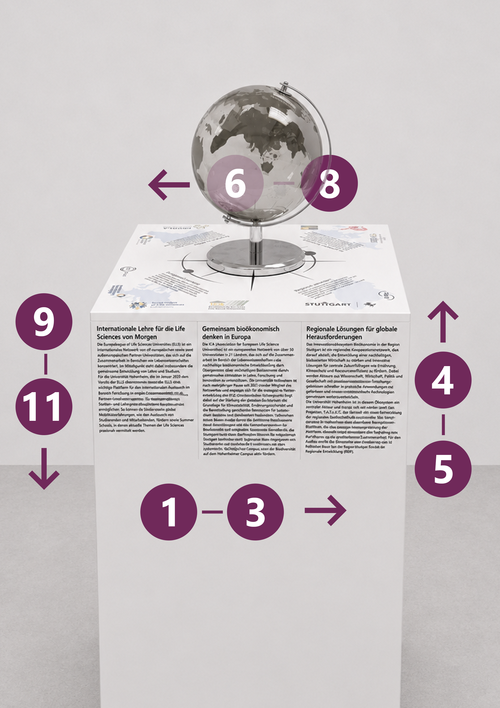
The Euroleague of Life Sciences Universities (ELLS) is an international network of eleven European and two non-European partner universities that focuses on collaboration in the field of life sciences (i.e., biology, human and veterinary medicine, agricultural and forestry sciences, food and nutritional sciences, environmental sciences and ecology, biotechnology, and many other disciplines). The focus is particularly on the joint development of teaching and academic programs. For the University of Hohenheim, which will assume the presidency of the ELLS in January 2026, the ELLS offers an important platform for international exchange in teaching. Close collaboration with partner universities results in a diverse range of joint study and teaching programs that provide students with an international and interdisciplinary learning environment. Particular emphasis is placed on mobility programs that promote the exchange of students and staff, as well as summer schools where current topics in the life sciences are taught in a practical manner.
A central component of the network's activities is the development and implementation of joint master's programs, as well as the annual Scientific Student Conference, where students from all partner universities can present their research and network internationally. Through these diverse activities, the University of Hohenheim actively contributes to strengthening teaching collaboration within the ELLS and further expanding international exchange in the life sciences.
The ICA (Association for European Life Science Universities) is a Europe-wide network of over 50 universities in 29 countries that focuses on collaboration in the fields of life sciences and the bioeconomy. Its work centers on topics such as sustainable agriculture, food systems, climate protection, the circular economy, biodiversity, and the sustainable use of natural resources. The ICA's goal is to support the transition to a sustainable European and global bioeconomy through joint activities in teaching, research, and innovation.
After a hiatus of several years, the University of Hohenheim rejoined this network in 2021 and is actively contributing to the ICA's strategic development. A particular focus is on strengthening biodiversity as a central foundation for climate stability, food security, and the provision of genetic resources for food, medicine, and bio-based materials. Within the ICA, the University of Hohenheim emphasizes in particular the role of education, research, and innovation as key drivers of sustainable transformation. At the university itself, this approach is implemented, among other things, through the interdisciplinary priority area of bioeconomy and through institutions such as the Center of Excellence for Biodiversity and Integrative Taxonomy (KomBioTa), which is operated jointly with the State Museum of Natural History in Stuttgart. In addition, students and researchers are involved in initiatives such as the "Ecological Campus" working group, which actively promotes biodiversity on the Hohenheim campus.
Through these activities, the University of Hohenheim contributes to integrating biodiversity more fully into agriculture, forestry, fisheries, bio-based industries, and urban development, and helps shape the transition to a sustainable circular economy within the European bioeconomy.
The Bioeconomy Innovation Ecosystem in the Stuttgart Region is a regional cooperation network aimed at strengthening the development of a sustainable, bio-based economy and promoting innovative solutions to key future challenges such as food security, climate protection, and resource efficiency. It connects stakeholders from science, industry, politics, and society to accelerate the translation of research findings into practical applications and to jointly advance new bioeconomic technologies.
The University of Hohenheim is a key scientific partner in this ecosystem, contributing its expertise in agricultural, food, and life sciences in particular. An important component of its participation is the C.A.T.A.L.I.S.T. project, which focuses on the further development of cellular agriculture. The goal is to scale up biotechnological production processes-such as those for proteins, fats, or flavors produced using microorganisms and fungi-from the successful laboratory scale to scalable, pilot-scale production. As part of the C.A.T.A.L.I.S.T. project, the University of Hohenheim is developing a scalable bioreactor platform that addresses a key challenge in cellular agriculture: the transition from research to large-scale industrial application. The university is receiving 1.1 million euros in funding from the European Regional Development Fund (ERDF) to establish this platform.
Through this initiative, the University of Hohenheim is making a significant contribution to the further development of the bioeconomy in the Stuttgart region and to bringing new, sustainable, and precise food production processes toward industrial application. In doing so, it supports the goals of the Circular Bioeconomy Strategy of the state capital Stuttgart as well as the Industrial Bioeconomy Strategy of the Stuttgart region.
Bioeconomy Innovation Ecosystem
https://www.stuttgart.de/wirtschaft/innovationsoekosysteme/biooekonomie/
The S-TEC Center "The Biointelligence Engine" is an interdisciplinary research and technology transfer center at the Stuttgart Technology and Innovation Campus (S-TEC). The center's goal is to bring together biology, engineering, and computer science to develop new solutions for industry, business, and society.
At the heart of this is the concept of biointelligence-the combination of biological systems with digital technologies such as artificial intelligence, sensor technology, and automation. This is intended to create more sustainable, efficient, and resilient products, processes, and business models.
As a partner, the University of Hohenheim contributes in particular its expertise in the fields of life sciences, agricultural and food research, and sustainability. Together with other research institutions and companies, it participates in the development and implementation of projects ranging from initial concept ideas to application-oriented demonstrators.
The network's core activities include joint research and innovation projects, knowledge transfer initiatives with companies, workshops, summer schools, and practice-oriented pilot projects. This strengthens the exchange between academia and industry and promotes the implementation of new technologies in real-world applications. Through the S-TEC Center, the University of Hohenheim helps to advance innovative and sustainable solutions at the intersection of biology and technology and actively shapes the transfer of knowledge between research and industry.
HERMES (Higher Education and Research in Management of European Universities) is an international university network in the fields of management and economics that connects universities from Europe, the United States, Australia, and other countries, and promotes collaboration in teaching, research, and academic exchange. The network's goal is to develop joint degree programs and enhance the international mobility of students, doctoral candidates, and faculty.
For the University of Hohenheim, HERMES is particularly relevant in the field of economics and social sciences. A central focus is on the development and implementation of double- and multiple-degree programs, through which students can earn international degrees. In addition, Hohenheim makes extensive use of the network for student exchanges, joint courses, and collaborative teaching formats with partner universities.The mobility of doctoral candidates also plays an important role, as does the expansion of research collaborations within the network. In terms of content, the collaboration focuses in particular on business administration, economics, data science, entrepreneurship, and sustainability. Through its active participation in HERMES, the University of Hohenheim is strengthening its international focus in the fields of management and economics and offering students and researchers a highly connected, globally oriented environment for study and research.
CHIKOH (China Expertise at Hohenheim) is a strategic initiative of the University of Hohenheim aimed at strengthening and expanding scientific, economic, and social cooperation with China over the long term. The focus is on building China expertise within the university, specifically by promoting knowledge, intercultural skills, and networks to facilitate successful collaborations with Chinese partner institutions.
An important component of CHIKOH is the promotion of research and exchange programs between the University of Hohenheim and Chinese partners, particularly in the fields of agricultural, food, and environmental sciences. A prime example of this is the German-Chinese Graduate College AMAIZE-P, which is conducted in collaboration with China Agricultural University (CAU) in Beijing. Since 2018, doctoral students from both universities have been conducting joint research there on the resource-efficient and more sustainable use of phosphate in maize cultivation. The goal is to optimize the use of phosphorus, a globally limited nutrient, while avoiding overfertilization. In addition, CHIKOH encompasses various initiatives to promote exchange and cooperation, including educational and professional development programs, networking activities, and forums such as the Hohenheim China Dialogue, where representatives from academia, business, and civil society discuss current developments in German-Chinese cooperation.
Through these activities, the University of Hohenheim contributes to the long-term deepening of relations with China in research and teaching, helps young researchers build international networks, and develops joint solutions to global challenges such as sustainable agriculture and resource conservation.
The BRIGHT-Futures project (Bright Spots in Agriculture - Learning from Today's Models for a Sustainable Future) at the University of Hohenheim is an interdisciplinary research project in the field of sustainability research and part of the university's focus on the sustainable use of natural resources. The project's goal is to identify and analyze successful examples of sustainable agricultural systems ("Bright Spots") in order to derive transferable principles for more sustainable agriculture.
At the heart of this is a new research approach: Instead of focusing exclusively on problems and shortcomings in agriculture, BRIGHT-Futures specifically examines sustainable systems that are already functioning. These so-called "bright spots" are characterized by being economically viable, socially just, climate-friendly, and conducive to biodiversity. By analyzing these examples, the underlying ecological and socio-economic mechanisms are to be understood. A particular focus is on interdisciplinary research in various regions around the world, including Germany (Baden-Württemberg and Bavaria), India, Kenya, and Mexico. There, successful local agricultural systems are being studied to better understand the conditions and success factors of sustainable agriculture and to make them comparable.The University of Hohenheim coordinates the project and is involved through several departments, particularly in ecology, social ecology, and sustainable agricultural science. BRIGHT-Futures is a long-term initiative (funding period through 2030/2031) and is supported by the Anton and Petra Ehrmann Foundation.
Through this project, the University of Hohenheim is helping to develop a scientifically sound foundation for a large-scale transformation toward sustainable agricultural and food systems and to make successful practical examples available internationally.
The African German Centre for Sustainable and Resilient Food Systems and Applied Agricultural and Food Data Science (UKUDLA) is a German-African network dedicated to sustainable food systems. It brings together research, education, and practical experience to develop solutions for food security-particularly in Africa. A key focus is on data-driven methods such as statistics, geodata, and artificial intelligence.
The center works across the entire food chain-from production to consumption-and uses this to develop concrete, practical solutions. In doing so, the partners draw on over 35 years of combined experience in research and international collaboration. Through the exchange of data, infrastructure, and knowledge, innovative approaches to sustainable food systems are created.For the University of Hohenheim, UKUDLA offers the opportunity to contribute its expertise on an international level and to collaborate closely with African partners. Together, they train specialists, implement research projects, and develop new technologies. At the same time, the network strengthens cooperation with international organizations and specifically promotes diversity as well as the inclusion of disadvantaged institutions.
UKUDLA is part of a major funding program run by the German Academic Exchange Service (DAAD) and is jointly supported by German and African partners. Various funding streams support education, research, and academic exchange. This fosters a strong, international network that contributes to the long-term improvement of food systems.
The African Bioeconomy University (ABU) is an initiative being established as a central platform for the bioeconomy in Africa. Its goal is to bring together education, research, and innovation to develop sustainable solutions for the economy, the environment, and society. In doing so, the ABU specifically draws on Africa's biological resources, scientific knowledge, and local expertise.
The ABU opens up new opportunities for Africa: It trains skilled professionals, promotes innovation, and supports the development of sustainable economic sectors-such as agriculture, energy, and biotechnology. At the same time, it strengthens collaboration between universities, policymakers, the business community, and international partners.The University of Hohenheim is contributing its experience from co-founding the European Bioeconomy University (EBU) and advising the initiative on establishing the ABU. In doing so, it is expanding its sphere of influence beyond Europe and supporting the international development of the bioeconomy.
The EIT Food network is a European innovation initiative in the food system sector that aims to promote a more sustainable, healthier, and more trustworthy food system in Europe. The network connects research institutions, companies, startups, and consumers to jointly develop innovations across the entire food value chain.As a Core Partner, the University of Hohenheim is actively involved in EIT Food, contributing its expertise particularly in the fields of agricultural and food sciences as well as sustainability. A key focus of its participation is on promoting innovation and entrepreneurship, especially by supporting startups and entrepreneurial initiatives in the agri-food sector.
In addition, Hohenheim is engaged in research and teaching activities related to sustainable food systems, in international student programs, and in practice-oriented educational formats that strengthen innovation and knowledge transfer between science, industry, and society. Through these activities, the university contributes to the development of sustainable solutions for global challenges in the food system.
The European Bioeconomy University Alliance (EBU) is a network of eight European universities working together to find solutions for a sustainable future. The focus is on the so-called bioeconomy-that is, the use of biological resources to make the environment, the economy, and food systems more sustainable.
The EBU offers significant advantages for the University of Hohenheim: it enables the university to collaborate closely with international partners, exchange knowledge, and develop joint research and teaching projects. This generates new ideas and innovative solutions that have an impact across national borders.Hohenheim's participation is primarily coordinated through the Bioeconomy Office. As the central point of contact, it connects researchers within the university as well as with partners across Europe. Through projects, workshops, and exchange and mobility programs (including the EBU doctoral network Destiny), Hohenheim actively contributes to the EBU network and helps to advance the bioeconomy together.
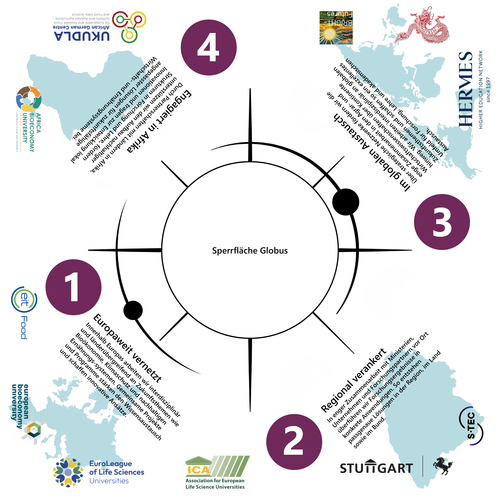
Within Europe, we work interdisciplinary and across borders to implment future-oriented topics such as the bioeconomy, climate protection, and sustainable food systems. Joint projects and programs empower the exchange of knowledge and generate innovative approaches.
Working closely with local ministries, companies, and research partners, we translate research findings into concrete applications. This leads to tailored solutions at regional, state, and federal levels.
Through strategic networks, we promote close collaboration in agricultural and economic sciences across continents. We take an interdisciplinary approach to global issues of the future, thereby creating an excellent environment for research, teaching, and academic exchange.
Through partnerships with countries in Africa, we support the development of sustainable structures in research and education, promote innovation, and contribute to the development of locally tailored solutions for sustainable economic and food systems.